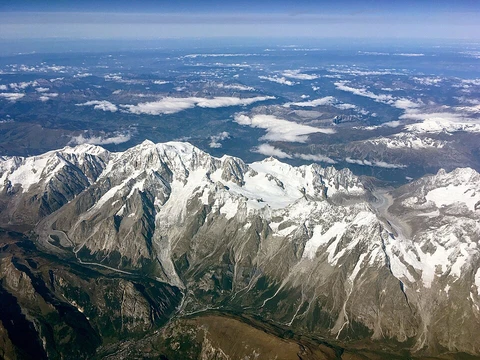
Sierra Nevada (U.S.)
Mountain range forming the western backbone of the Americas.

The Sierra Nevada is a mountain range in the Western United States, located between the Central Valley of California and the Great Basin.
- Location
- Primarily in California, with the Carson Range in Nevada
- Notable features
- General Sherman Tree, Lake Tahoe, Yosemite Valley
- Protected areas
- Three national parks, 26 wilderness areas, 10 national forests, 2 national monuments
Lore & Background
The Sierra Nevada's western slope is drained by the Central Valley watershed, including the Sacramento and San Joaquin rivers, while the eastern slope rivers flow into the endorheic Great Basin. Notable features include Lake Tahoe, the largest alpine lake in the United States by volume; Yosemite Valley, sculpted by glaciers from one-hundred-million-year-old granite; and groves of giant sequoias, the largest trees in the world.
Reader's Guide
The Sierra Nevada is significant as a major geographical and historical feature of the Western United States. It contains the highest point in the contiguous United States, Mount Whitney, and the largest tree by volume, the General Sherman Tree. The range's five life zones reflect a wide range of elevations and climates, supporting diverse plant and animal communities. The Sierra Nevada is also a hub for conservation, with three national parks, 26 wilderness areas, ten national forests, and two national monuments, including Yosemite, Sequoia, and Kings Canyon National Parks. The range's watersheds provide water to much of California, including the Los Angeles Aqueduct, which diverts streams from Mono Lake southwards. The Sierra Nevada's legacy includes its role in shaping California's economy, ecology, and recreation, as well as its cultural impact through literature and photography.
Did You Know?
- The name 'Sierra Nevada' translates literally to 'snowy mountains' from Spanish.
Position in the Global Length Rankings
Within the comprehensive catalogue of Earth's mountain systems, the Sierra Nevada of the United States holds a specific and measurable place. Its position in this hierarchy underscores that while the Sierra Nevada is a significant feature, it occupies the lower reaches of the global length spectrum.
A Segment of the North American Cordillera
This structural relationship situates the Sierra Nevada as one thread in a much larger tectonic and geographic tapestry.
Comparative Scale Across Continents
The list also includes ranges on other celestial bodies and underwater features, reminding the reader that the Sierra Nevada is one terrestrial thread among a far wider catalog of geological formations spanning Earth's continents, its oceans, and even other astronomical bodies.
The Cataloguing Framework and Its Place
The Sierra Nevada (U.S.) appears within a carefully structured reference work that organizes Earth's mountain ranges along multiple axes. After these ranked lists, the source material proceeds to more comprehensive alphabetical listings organized by continent, followed by ranges found in the oceans and on other celestial bodies. The Sierra Nevada's placement among continental ranges, rather than oceanic or extraterrestrial entries, marks it as a feature of terrestrial geology. Its designation as a section of the North American Cordillera further anchors it within a specific continental and tectonic context. The fact that it appears in this particular register, neither among the highest peaks nor the longest chains but squarely in the mid-range of continental mountain systems, reflects its identity as a substantial but not record-breaking formation in the global inventory of Earth's topography.
Frequently Asked Questions
What is the Sierra Nevada (U.S.)?
It is a major north-south mountain range in the Western United States that runs along the eastern edge of California's Central Valley and borders the Great Basin to the east. It is a key segment of the American Cordillera, the great western mountain spine of the Americas.
What are the Sierra Nevada's most iconic features?
Fans of the range point to Yosemite Valley, the General Sherman Tree (the largest living tree by volume), and Lake Tahoe as the highlights. The range also includes the Carson Range on the Nevada side, tying it to two states.
How much of the Sierra Nevada is under protection?
The range is home to three national parks, 26 designated wilderness areas, ten national forests, and two national monuments. This extensive network makes it one of the most heavily protected mountain systems in the country.
More in Mountain Ranges And Massifs 25-29
Elsewhere in the Mountain Ranges And Massifs universe
Spotted an error? Know more?
This is a living reference — every entry is fact-audited, and reader corrections feed straight into our audit queue. Suggest an edit · See this site's audit record