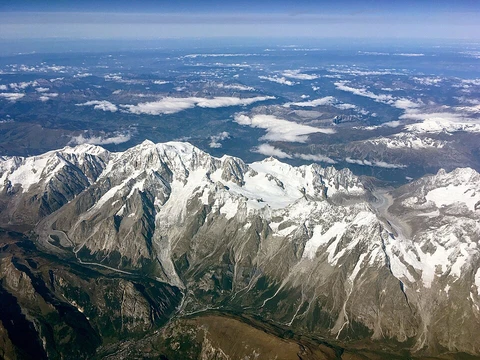
American Cordillera
A continuous chain of mountain ranges forming the western backbone of the Americas.

The American Cordillera is a chain of mountain ranges (cordilleras) forming an almost continuous sequence that runs through the western Americas.
- type
- Mountain range system
- location
- Western Americas, from Alaska to Antarctica
- highest_peak
- Aconcagua
- known_for
- Forming the eastern half of the Pacific Ring of Fire
- subdivisions
- Includes Alaska Range, Brooks Range, Rocky Mountains, Columbia Mountains, Coast
Lore & Background
In the United States, the Cordillera branches include the Rockies, the Sierra Nevada, the Cascades, and various small Pacific coastal ranges.
Reader's Guide
The American Cordillera is significant as a nearly continuous sequence of mountain ranges that defines the western edge of the Americas, influencing climate, ecology, and human settlement across multiple countries. The Cordillera's highest peak, Aconcagua, is a notable landmark. This vast chain includes major ranges such as the Rocky Mountains, Sierra Nevada, Cascades, and Andes, each contributing to the geological and geographical character of their regions. The Cordillera's continuity underscores the interconnectedness of the Americas' western landscapes, from the Arctic to the Antarctic.
Did You Know?
- The American Cordillera stretches approximately 13,400 kilometers (8,300 miles), making it the third-longest mountain system on Earth after the Mid-ocean ridge and the Ring of Fire.
- The Andes, at 7,000 kilometers, and the North American Cordillera, at 6,400 kilometers, are the two principal components of the American Cordillera.
- The Rocky Mountains, spanning 4,830 kilometers, form the backbone of the North American Cordillera.
- In Colombia, the Cordillera Occidental and Cordillera Oriental each measure approximately 1,200 kilometers, while the Cordillera Central extends 1,023 kilometers.
- The American Cordillera's volcanic arc forms the eastern half of the Pacific Ring of Fire.
Global Scale and Continental Ranking
The American Cordillera stretches approximately 13,400 kilometers (8,300 miles), placing it among the most extensive mountain systems on the planet. In the comprehensive catalog of Earth's mountain ranges organized by length, it ranks as the third-longest entry, trailing only the underwater Mid-ocean ridge at 65,000 kilometers and the Ring of Fire at 40,000 kilometers. It significantly exceeds the Andes at 7,000 kilometers and the North American Cordillera at 6,400 kilometers, which together constitute its two principal components. The Alpine-Himalayan orogenic belt, at over 15,000 kilometers, is the only other continental-scale system that surpasses it in total extent.
The North American Component
The North American Cordillera, at 6,400 kilometers (4,000 miles), constitutes the northern half of the American Cordillera and encompasses a remarkable diversity of sub-ranges. The Rocky Mountains, spanning 4,830 kilometers, form the backbone of this system. To the west, the Coast Mountains extend 1,600 kilometers, while the California Coast Ranges and the Sierra Nevada each cover roughly 640 kilometers. In the interior and southern reaches, the Peninsular mountain ranges stretch 1,500 kilometers, and the Sierra Madre Occidental and Sierra Madre del Sur add 1,500 and 1,000 kilometers respectively. Further north, the Brooks Range at 1,100 kilometers and the Alaska Range at 650 kilometers anchor the system's Arctic and sub-Arctic extremities. Together, these subsections create a continuous orographic framework that defines the western and central geography of North America across a vast latitudinal span.
The Andean Component and Its Parallel Architecture
The Andes, stretching 7,000 kilometers (4,300 miles), form the southern and equatorial portion of the American Cordillera. They are divided into Northern and Southern Andes, and both subdivisions are characterized by three vast, nearly parallel chain systems running along their length: the Cordillera Occidental, the Cordillera Central, and the Cordillera Oriental. In Colombia, the Cordillera Occidental and Cordillera Oriental each measure approximately 1,200 kilometers, while the Cordillera Central extends 1,023 kilometers. The Precordillera, at 800 kilometers, is considered a section of the Southern Andes within the broader American Cordillera. This tripartite parallel structure gives the Andes a distinctive layered architecture that distinguishes them from many other major ranges and contributes to the extraordinary topographic complexity of South America's western margin.
Place in the Global Mountain-Range Taxonomy
Within the broader taxonomy of Earth's mountain ranges, the American Cordillera occupies a distinctive position. The reference catalog organizes ranges first by height, listing the 23 highest all above 5,000 meters, then by prominence, and finally by length. The American Cordillera appears in the length-based listing of mountain systems exceeding 500 kilometers, where it is grouped alongside other major orogenic features such as the Alpine-Himalayan belt, the Great Escarpment of Southern Africa, and the Great Dividing Range of Australia. The catalog also includes ranges on other celestial bodies and underwater systems, placing the American Cordillera in a truly global and even extraterrestrial context. Its 13,400-kilometer span positions it between the Ring of Fire and the Andes in the ranking, and its inclusion in the same reference framework as the Mid-ocean ridge underscores its significance as one of the planet's most structurally important features.
Frequently Asked Questions
What is the American Cordillera?
It is a nearly unbroken chain of mountain ranges running along the western edge of the Americas, serving as the continent's structural spine on that side.
What role does the American Cordillera play in plate tectonics?
It constitutes the backbone of the volcanic arc that makes up the eastern portion of the Pacific Ring of Fire, so its geology is largely shaped by subduction and volcanic activity.
Which major ranges are included in the American Cordillera?
The system spans from the Alaska Range and Brooks Range in the north, through the Rockies, Cascades, Sierra Nevada, Coast Ranges, and both Sierra Madres, all the way down to the Andes in the south.
How far does the American Cordillera extend geographically?
It stretches as a continuous sequence from Alaska in the far north all the way down to Antarctica, covering the full western margin of the Americas.
Why is the American Cordillera considered significant?
Beyond defining the topography of the western Americas, it is one of the most seismically and volcanically active mountain systems on Earth, profoundly shaping regional climate, ecology, and human settlement.
More in Mountain Ranges And Massifs 1-24
Related in Mountain Ranges And Massifs
Links follow this subject's own source article.
Elsewhere in the Mountain Ranges And Massifs universe
Spotted an error? Know more?
This is a living reference — every entry is fact-audited, and reader corrections feed straight into our audit queue. Suggest an edit · See this site's audit record