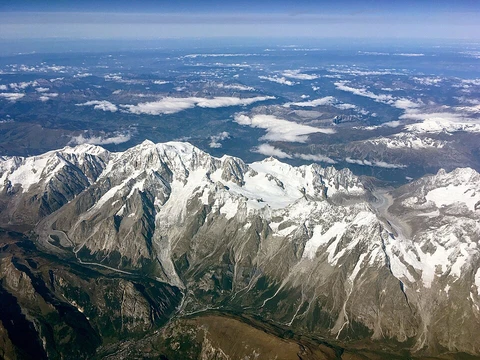
Appalachian Mountains
Ancient mountain range spanning eastern North America.

The Appalachian Mountains are a mountain range stretching ~2,050 miles from Newfoundland and Labrador, Canada to Alabama, US. The Appalachians, at their initial formation, were a part of the larger Central Pangean Mountains along with the Scottish Highlands, the Ouachita Mountains, and the Anti-Atlas Mountains. The modern ranges were formed and/or deformed by the Acadian, Caledonian, Alleghenian, Mauritanide and Variscan orogenies with the Alleghenian orogeny being the most notable to the modern Appalachians.
- Length
- ~2,050 miles
Lore & Background
The Appalachians, at their initial formation, were a part of the larger Central Pangean Mountains along with the Scottish Highlands, the Ouachita Mountains, and the Anti-Atlas Mountains. The modern ranges were formed and/or deformed by the Acadian, Caledonian, Alleghenian, Mauritanide and Variscan orogenies with the Alleghenian orogeny being the most notable to the modern Appalachians. The Appalachians are also subdivided by a number of large plateaus and additional subplateaus. These are commonly not considered subranges although they do contain some features referred to as mountains which are assigned to both their geographic 'range' and the more general Appalachian Mountains. These plateaus, such as the Allegheny Plateau, are considered provinces of the Appalachian Highlands and the mountains assigned to them are instead considered pieces of dissected plateaus. Additionally, subranges and ridges of subranges (Such as the Yew Mountains) are inconsistently related to the Appalachian Mountain Range. No clear distinction exists as to what units qualify as directly related subranges of the Appalachians until the level of mountain. As such, the distinction is often arbitrary and based on personal preference by the geographer or geologist publishing material. This has led to the distinction being largely unrelated to area, geological features, or topography.
Reader's Guide
Colloquially, all mountains in Vermont are referred to as the Green Mountains, although not all are a part of the geological range. The Northeast Kingdom is not in the range, but is considered as containing Green Mountains. The Canadian government considers the Megantic Hills and Notre Dame Mountains as two physiographic provinces within the Appalachian Uplands region. Conversely, the government of Quebec considers the Notre Dame and Mégantic Mountains to be a physiographic region and does not recognize the Appalachian Uplands. This list primarily uses the Canadian Geological Survey's dictations on physiographic regions, divisions, sections, and subsections. Due to the lack of solid distinctions in the requirements of an area to be a range, this list includes most physiographic divisions, many larger ridges, plateaus, mountain complexes, most stratigraphic ridges, certain lowlands and uplands, local highlands, and certain other types of geographic and geological features. This list is not a comprehensive list of every peak and summit of the Appalachians, individual mountains, when included, are generally individual politically but not geographically, and each inclusion must meet the set of criteria used to define a subrange.
Did You Know?
- The Appalachians, at their initial formation, were a part of the larger Central Pangean Mountains along with the Scottish Highlands, the Ouachita Mountains, and the Anti-Atlas Mountains.
- The modern ranges were formed and/or deformed by the Acadian, Caledonian, Alleghenian, Mauritanide and Variscan orogenies with the Alleghenian orogeny being the most notable to the modern Appalachians.
- The Allegheny Plateau is considered a province of the Appalachian Highlands and the mountains assigned to it are instead considered pieces of dissected plateaus.
- The Canadian government considers the Megantic Hills and Notre Dame Mountains as two physiographic provinces within the Appalachian Uplands region, while the government of Quebec considers the Notre Dame and Mégantic Mountains to be a physiographic region and does not recognize the Appalachian Uplands.
- Colloquially, all mountains in Vermont are referred to as the Green Mountains, although not all are a part of the geological range; the Northeast Kingdom is not in the range, but is considered as containing Green Mountains.
A Place in the Global Length Hierarchy
The Appalachian Mountains stretch 2,414 kilometres (1,500 miles) from end to end, a measurement that secures their position in the upper-middle tier of Earth's longest mountain ranges. Yet they fall just short of the Ural Mountains and the Atlas range, both listed at 2,500 kilometres, and trail the main Himalayan section by a similar margin. Their length is a testament to a geological formation that, while not the most elevated on the planet, commands a considerable stretch of terrain.
Standing Apart from the Great Orogenic Belts
One of the most telling details in global mountain-range inventories is how the Appalachian Mountains are catalogued as a standalone entry, without the parenthetical notation that links so many other ranges to larger tectonic systems. The Atlas, Kunlun, Carpathian, Taurus, Zagros, and Alpine ranges are all explicitly identified as sections of the Alpine-Himalayan orogenic belt. The Appalachians, by contrast, receive no such subordination in these listings. This independent classification underscores that the Appalachians represent a distinct geological formation in their own right, recognized on world lists for their own merits rather than as a component of a broader orogenic structure.
Beyond the Realm of the Highest Peaks
The most exclusive tier in any mountain-range catalogue is reserved for the twenty-three highest systems on Earth, every one of which rises above the 5,000-metre (16,404-foot) threshold. The Appalachian Mountains do not appear in that select group. This does not diminish their significance as a 2,414-kilometre stretch of terrain, but it does place them in a fundamentally different geological conversation. The highest ranges are actively rising—driven by the ongoing collision of the Indian and Eurasian plates, with the Himalayas climbing most rapidly—while the Appalachians exist in a world of their own, defined by length and continuity rather than by the extreme vertical ambition that characterizes the planet's most elevated mountain systems.
A Length That Spans Continents of Comparison
At 2,414 kilometres, the Appalachian Mountains occupy a fascinating middle ground when compared against the full spectrum of Earth's mountain ranges. This positioning means the Appalachians are a range of substantial continental scale—long enough to rival many of the world's most recognized chains—while remaining distinctly separate from the truly colossal systems that define the extremes of Earth's topography.
Frequently Asked Questions
What are the Appalachian Mountains?
The Appalachian Mountains are a long, ancient chain of peaks and ridges running through the eastern portion of North America. They stretch from central Alabama up toward Newfoundland, forming the geological backbone of that entire region.
How long is the Appalachian Mountain range?
The range covers roughly 2,050 miles (about 3,300 km) along a southwest-to-northeast axis. When you include the broader Appalachian Plateau province, the system extends even further.
What is the tallest peak in the Appalachians?
Mount Mitchell, located in North Carolina's Black Mountains subrange within the larger Blue Ridge system, tops out at 6,684 feet (2,037 m). It is the highest point within the entire Appalachian range.
How old are the Appalachian Mountains?
The range was shaped by at least three major tectic collision events that began around 480 million years ago, making it one of the oldest mountain systems on Earth. Some of its deepest rocks reach back to the Precambrian era, roughly 1.1 billion years old.
Do the Appalachian Mountains cross international borders?
Yes — the range technically touches three sovereign nations: the United States, Canada, and France. The French overseas collectivity of Saint Pierre and Miquelon sits within the range's broader extent, a trivia point many fans love.
More in Mountain Ranges And Massifs 1-24
Related in Mountain Ranges And Massifs
Links follow this subject's own source article.
Elsewhere in the Mountain Ranges And Massifs universe
Spotted an error? Know more?
This is a living reference — every entry is fact-audited, and reader corrections feed straight into our audit queue. Suggest an edit · See this site's audit record