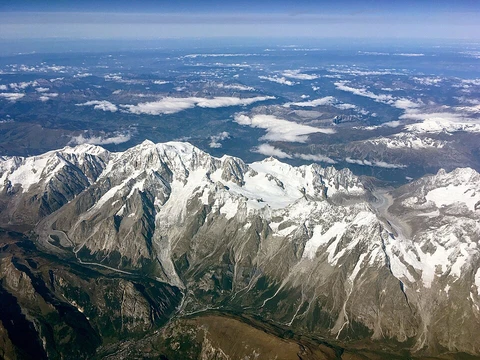
Atlas Mountains
North African mountain range separating Sahara from Mediterranean and Atlantic.

The Atlas Mountains are a mountain range in the Maghreb in North Africa, stretching around 2,500 km (1,600 mi) through Morocco, Algeria and Tunisia. They separate the Sahara from the Mediterranean Sea and the Atlantic Ocean. The range's highest peak is Toubkal, in central Morocco, with an elevation of 4,167 metres (13,671 ft). The Atlas Mountains are primarily inhabited by Berber populations. The terms for 'mountain' are Adrar and adras in some Berber languages, and these terms are believed to be cognates of the toponym Atlas. The mountains are associated with the Titan Atlas.
- Highest peak
- Toubkal, 4,167 m (13,671 ft)
- Location
- Morocco, Algeria, Tunisia
- Length
- Approximately 2,500 km (1,600 mi)
- Primary inhabitants
- Berber populations
- Major subranges
- Anti-Atlas, High Atlas, Middle Atlas, Tell Atlas, Saharan Atlas, Aurès Mountains
- Natural resources
- Iron ore, lead ore, copper, silver, mercury, rock salt, phosphate, marble, anthr
Lore & Background
The Atlas Mountains were formed during three subsequent phases of Earth's geology. The first tectonic deformation phase involves only the Anti-Atlas, which was formed in the Paleozoic Era (~300 million years ago) as the result of continental collisions. The Anti-Atlas Mountains are believed to have originally been formed as part of the Alleghenian orogeny, when Africa and America collided, and were once a chain rivaling today's Himalayas. A second phase took place during the Mesozoic Era (before ~66 My), consisting of a widespread extension of the Earth's crust that rifted and separated the continents. This extension was responsible for the formation of many thick intracontinental sedimentary basins including the present Atlas. In the Paleogene and Neogene Periods (~66 million to ~1.8 million years ago), the mountain chains that today constitute the Atlas were uplifted, as the land masses of Europe and Africa collided at the southern end of the Iberian Peninsula. However, there is a lack of evidence for the nature of the subduction in the Atlas region, or for the thickening of the Earth's crust generally associated with continental collisions. Recent studies suggest that deep processes rooted in the Earth's mantle may have contributed to the uplift of the High and Middle Atlas.
Reader's Guide
The Atlas Mountains are rich in natural resources, including deposits of iron ore, lead ore, copper, silver, mercury, rock salt, phosphate, marble, anthracite coal and natural gas. The range can be divided into four general regions: Anti-Atlas, High Atlas and Middle Atlas (Morocco); Tell Atlas (Morocco, Algeria, Tunisia); Aurès Mountains (Algeria, Tunisia); and Saharan Atlas (Algeria). The High Atlas in central Morocco rises at the Atlantic coast and stretches east to the Moroccan-Algerian border, with several peaks over 4,000 m (13,000 ft), including the highest summit in North Africa, Toubkal (4,167 m or 13,671 ft). The Middle Atlas is completely in Morocco and is the northernmost of its three main Atlas ranges, experiencing more rain than the ranges to the south and home to the majority of the world's population of Barbary macaque. The Tell Atlas is a mountain chain over 1,500 kilometres (900 mi) in length, stretching from Eastern Morocco to Tunisia, and through Algeria, with the highest summit being the 2,308 m (7,572 ft) Lalla Khadidja. The Aurès Mountains are the easternmost portion of the Atlas mountain range, covering parts of Algeria and Tunisia. Flora in the mountains include the Atlas cedar, evergreen oak and many semi-evergreen oaks such as the Algerian oak. Animals that live in the area include the Barbary macaque, Barbary leopard, Barbary stag, Barbary sheep, Atlas Mountain badger, Cuvier's gazelle, North African boar, striped hyena, red fox, northern bald ibis, Algerian nuthatch, dipper, and Atlas mountain viper. Many animals used to inhabit the Atlas mountains such as the Atlas bear, North African elephant, North African aurochs, bubal hartebeest and Atlas wild ass, but these subspecies are all extinct. Barbary lions are currently extinct in the wild, but descendants exist in captivity.
Did You Know?
- The Berber terms for 'mountain'—Adrar and adras—are believed to be cognates of the toponym Atlas.
- The Anti-Atlas Mountains were once a chain rivaling today's Himalayas when Africa and America collided.
- The highest peak in North Africa, Toubkal, has an elevation of 4,167 metres (13,671 ft).
- The Middle Atlas is home to the majority of the world's population of Barbary macaque.
- Barbary lions are currently extinct in the wild, but descendants exist in captivity.
Frequently Asked Questions
Who is Atlas Mountains?
Atlas Mountains is a roughly 2,500-kilometer range running through Morocco, Algeria, and Tunisia in the Maghreb region of North Africa. It is home primarily to Berber communities, and its name is linked both to the Titan Atlas of Greek myth and to Berber words for 'mountain' such as Adrar and adras.
What are Atlas Mountains's powers/role?
The range functions as a natural wall separating the Sahara Desert from the Mediterranean Sea and the Atlantic Ocean, shaping climate and ecology on both sides. It also stores substantial mineral wealth, including iron and lead ores, copper, silver, phosphate, and natural gas.
How does Atlas Mountains's story end?
Because it is a living geological formation rather than a narrative character, Atlas Mountains has no fixed ending; it continues to influence North African weather and ecosystems today. Its highest summit, Toubkal at 4,167 meters, remains an active site for mountaineering and scientific study.
Why is Atlas Mountains important?
It is the principal geographic divider between the arid Sahara to the south and the Mediterranean and Atlantic coasts to the north, making it essential to the climate and water systems of the entire Maghreb. Its deposits of rock salt, marble, anthracite coal, and natural gas also give it lasting economic significance for Morocco, Algeria, and Tunisia.
What are Atlas Mountains's major subranges/affiliates?
The range is composed of several distinct subranges, including the High Atlas, Middle Atlas, Anti-Atlas, Tell Atlas, Saharan Atlas, and the Aurès Mountains. Together these form a continuous but varied system of peaks, plateaus, and valleys spanning roughly 1,600 miles.
More in Mountain Ranges And Massifs 1-24
Elsewhere in the Mountain Ranges And Massifs universe
Spotted an error? Know more?
This is a living reference — every entry is fact-audited, and reader corrections feed straight into our audit queue. Suggest an edit · See this site's audit record