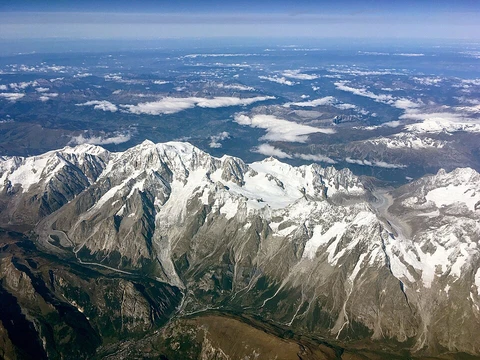
Blue Mountains (Pacific Northwest)
Mountain range in Oregon and Washington, home to largest fungus.

The Blue Mountains are a mountain range in the northwestern United States, located largely in northeastern Oregon and stretching into extreme southeastern Washington. The Blue Mountains are unique as the home of the world's largest living organism, a subterranean colonial mycelial mat of the fungus Armillaria ostoyae.
- States
- Oregon and Washington
- Counties
- Union, Umatilla, Grant, Baker, Wallowa, Harney (Oregon); Walla Walla, Columbia, Garfield, Asotin (Washington)
- Notable feature
- World's largest living organism (Armillaria ostoyae)
Lore & Background
The Blue Mountains were named after the color of the mountains when seen from a distance and the blue hue imparted by the smoke of forest and range fires set by Indigenous people as management tools in the fall. The range includes several mountain ranges, from the Ochoco Mountains and Maury Mountains in the west near Prineville, Oregon, through the Greenhorn Mountains, the Aldrich Mountains, and the Strawberry Range, to the Elkhorn Mountains. The range is drained by several rivers, including the Grande Ronde and Tucannon, tributaries of the Snake, as well as the forks of the John Day, Umatilla and Walla Walla rivers, tributaries of the Columbia. The southernmost portion is drained by the Silvies River, in the endorheic Harney Basin. The oldest rocks were created as island arcs in the Pacific Ocean and accreted onto the North American plate.
Reader's Guide
The Blue Mountains hold significance as a major geographic feature of the Pacific Northwest, serving as a formidable obstacle for settlers on the Oregon Trail in the mid-1800s. The range is currently traversed by Interstate 84 and U.S. Route 26, as well as the Union Pacific Railroad's mainline. The mountains are home to diverse wildlife, including Rocky Mountain elk, Bighorn sheep, Mule deer, and numerous bird species such as bald eagle and Lewis's woodpecker. The range is managed by the United States Forest Service, Bureau of Land Management, private landowners, and the Confederated Tribes of the Umatilla Indian Reservation. The Blue Mountains are also notable for containing the world's largest living organism, a subterranean colonial mycelial mat of the fungus Armillaria ostoyae.
Did You Know?
- The Blue Mountains were named after the blue hue imparted by smoke from fires set by Indigenous people as management tools.
- The range is home to the world's largest living organism, a subterranean colonial mycelial mat of the fungus Armillaria ostoyae.
- The Blue Mountains cover ten counties across two states: Oregon and Washington.
Frequently Asked Questions
What is the Blue Mountains' most famous feature or 'power'?
The range shelters the world's largest known single living organism, a vast underground colonial network of the honey fungus Armillaria ostoyae. This mycelial mat spreads beneath the forest floor over an enormous area, dwarfing virtually every other living entity on the planet.
How did the Blue Mountains get their name?
The name comes from the distinctive blue-tinted haze that hovers over the peaks, produced by smoke from controlled burns historically set by Indigenous peoples as a land-management practice. That recurring blue glow, visible from a great distance, gave the range its enduring nickname.
Why is the Blue Mountains important in the broader landscape?
Beyond its sheer size, the range is ecologically significant because it hosts the planet's largest living organism and supports diverse dry-forest ecosystems. Its semi-arid climate and high elevation set it clearly apart from the wetter Cascades just to the west.
More in Mountain Ranges And Massifs 1-24
Elsewhere in the Mountain Ranges And Massifs universe
Spotted an error? Know more?
This is a living reference — every entry is fact-audited, and reader corrections feed straight into our audit queue. Suggest an edit · See this site's audit record