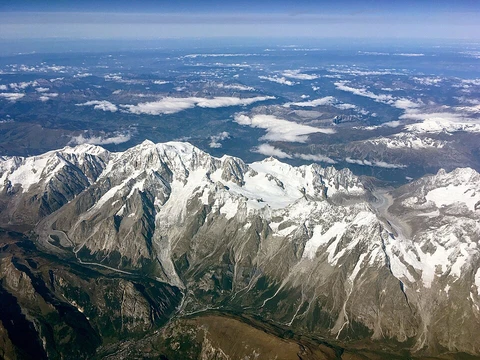
Carpathian Mountains
Europe's third-longest mountain range, forming an arc across Central and Southeast Europe.

The Carpathian Mountains are a range forming an arc across Central and Southeast Europe, roughly 1,500 km long, making them the third-longest European mountain range after the Urals and the Scandinavian Mountains. They stretch from the Western Carpathians in Austria, the Czech Republic, Slovakia, and Poland, clockwise through the Eastern Carpathians in Ukraine and Romania, to the Southern Carpathians in Romania and Serbia. The highest peaks are in the Tatra Mountains, exceeding 2,600 m, closely followed by those in the Southern Carpathians in Romania, exceeding 2,550 m. The Carpathians provide habitat for the largest European populations of brown bears, wolves, chamois, and lynxes, with the highest concentration in Romania, as well as over one-third of all European plant species. The mountains and their foothills also have many thermal and mineral waters, with Romania having one-third of the European total.
- length
- Roughly 1,500 km (930 mi)
- highest_peak
- Gerlachovský štít in Slovakia, 2,655 m (8,711 ft)
- area
- 190,000 km² (73,000 sq mi)
- countries
- Austria, Czech Republic, Slovakia, Poland, Ukraine, Romania, Serbia
- major_subranges
- Western Carpathians, Eastern Carpathians, Southern Carpathians, Outer Carpathian
- notable_wildlife
- Largest European populations of brown bears, wolves, chamois, and lynxes
Lore & Background
The Carpathians do not form an uninterrupted chain but consist of several orographically and geologically distinctive groups. The northwestern Carpathians begin in Slovakia and southern Poland, surrounding Transcarpathia and Transylvania in a large semicircle, sweeping towards the southeast, and end on the Danube near Orșova in Romania. The highest altitudes occur where the range is widest, in the Transylvanian plateau and the southern Tatra Mountains group. The highest range, in which Gerlachovský štít in Slovakia is the highest peak, is 2,655 m above sea level. The Carpathians were formed during the Alpine orogeny in the Mesozoic and Cenozoic by moving the ALCAPA, Tisza, and Dacia plates over subducting oceanic crust. Currently, the area is the most seismically active in Central Europe. The name 'Carpates' is first recorded in Ptolemy's Geographia from the second century AD. In late Roman documents, the Eastern Carpathians were referred to as Montes Sarmatici. The etymology is not clearly established but is highly associated with the old Dacian tribes called Carpes or Carpi who lived east of the Carpathians.
Reader's Guide
The Carpathian Mountains are the third-longest European mountain range, covering 190,000 km² and spanning seven countries: Austria (1%), Czech Republic (3%), Slovakia (21%), Poland (10%), Ukraine (10%), Romania (50%), and Serbia (5%). They provide habitat for the largest European populations of brown bears, wolves, chamois, and lynxes, with the highest concentration in Romania, as well as over one-third of all European plant species. Romania holds the second-largest area of virgin forests in Europe after Russia, totaling 250,000 hectares (65%), most in the Carpathians, with the Southern Carpathians constituting Europe's largest unfragmented forest area. However, rates of forest loss due to clearcutting and illegal logging are high. The range also contains numerous thermal and mineral waters, with Romania having one-third of Europe's total. The highest peak is Gerlachovský štít in Slovakia at 2,655 m. The Carpathians are separated from the Alps by the Danube, only meeting at the Leitha Mountains at Bratislava. The river also separates the Carpathians from the Balkan Mountains at Orșova in Romania.
Did You Know?
- The Carpathians are the third-longest European mountain range, after the Urals at 2,500 km and the Scandinavian Mountains at 1,700 km.
- Romania has one-third of Europe's total thermal and mineral waters, most in the Carpathians.
- The Southern Carpathians contain Europe's largest unfragmented forest area.
- The name 'Carpates' was first recorded in Ptolemy's Geographia in the second century AD.
- The Carpathians are currently the most seismically active area in Central Europe.
Frequently Asked Questions
What are the Carpathian Mountains?
The Carpathians are a sweeping arc-shaped range that threads through Central and Southeast Europe. At roughly 1,500 kilometers in length, they are the third-longest mountain system on the continent.
How long are the Carpathian Mountains and what is their total area?
The range spans approximately 1,500 km (930 mi) from its western reaches in Austria and Poland to its southern tip in Serbia. The full system covers about 190,000 km² (73,000 sq mi) of terrain.
What is the highest peak in the Carpathian Mountains?
Gerlachovský štít in Slovakia is the range's summit, rising to 2,655 m (8,711 ft) above sea level. It is the tallest point across all Western, Eastern, and Southern Carpathian subranges.
What wildlife makes the Carpathian Mountains special?
The Carpathians are home to the largest European populations of brown bears, wolves, chamois, and lynxes. The range also harbors more than one-third of every plant species found across the continent.
Which countries do the Carpathian Mountains pass through?
The arc crosses seven nations: Austria, the Czech Republic, Slovakia, Poland, Ukraine, Romania, and Serbia. The range is traditionally divided into Western, Eastern, Southern, and Outer Carpathian subranges.
More in Mountain Ranges And Massifs 1-24
Related in Mountain Ranges And Massifs
Links follow this subject's own source article.
Elsewhere in the Mountain Ranges And Massifs universe
Spotted an error? Know more?
This is a living reference — every entry is fact-audited, and reader corrections feed straight into our audit queue. Suggest an edit · See this site's audit record