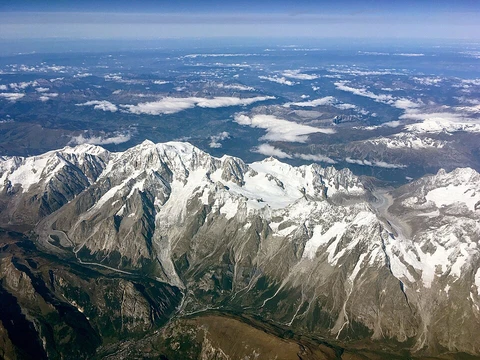
Caucasus Mountains
Mountain range at the Asia-Europe border, home to Europe's highest peak.

- Location
- Intersection of Asia and Europe, between Black Sea and Caspian Sea
- Major subdivisions
- Greater Caucasus and Lesser Caucasus
- Geological system
- Alpide belt
- Notable feature
- Part of the Silk Road
Lore & Background
Geologically, the Caucasus Mountains belong to the Alpide belt system and formed largely from the collision of the Arabian plate moving northwards with respect to the Eurasian plate. The Greater Caucasus are mainly composed of Cretaceous and Jurassic rocks, with Paleozoic and Precambrian rocks in higher regions, while the Lesser Caucasus are formed predominantly of Paleogene rocks. The entire region is regularly subjected to strong earthquakes, and contemporary seismic activity reflects active faulting and crustal shortening. The climate varies vertically and horizontally, with temperature decreasing as elevation rises. Precipitation increases from east to west, with the Western Caucasus receiving 1,000 to 4,000 mm annually and the Lesser Caucasus Mountains receiving 300-800 mm. The Caucasus Mountains are known for heavy snowfall, especially on the southwestern slopes of the Greater Caucasus, where snow cover can reach 5 metres, and the Mt. Achishkho region records depths of 7 m. The landscape includes biomes from subtropical lowland marshes and forests to glaciers, highland semideserts, steppes, and alpine meadows.
Reader's Guide
The Caucasus Mountains hold significance as a natural border between Asia and Europe, with the Greater Caucasus Watershed often defining the continental boundary. The range's geological history, shaped by plate tectonics and volcanic activity, has produced notable peaks such as Elbrus and Kazbek, the latter formed as Pleistocene-Pliocene volcanoes. Their varied climate and landscape support diverse ecosystems, from Colchian forests to alpine meadows, and the heavy snowfall in certain areas makes them notable for snow depth records. The mountains continue to be a subject of geographical and geological study, reflecting their complex position between continents and their dynamic natural history.
Did You Know?
- The Caucasus Mountains are listed as a section of the Alpine-Himalayan orogenic belt, with a length of 1,200 km (750 mi).
- The Greater Caucasus is 1,200 km (750 mi) long, while the Lesser Caucasus is 600 km (370 mi) long.
- The Caucasus Mountains are located at the intersection of Asia and Europe, between the Black Sea and the Caspian Sea.
Frequently Asked Questions
Who is Caucasus Mountains?
The Caucasus Mountains are a major mountain range sitting right at the border where Asia meets Europe, spanning from the Black Sea to the Caspian Sea. They contain both the Greater Caucasus to the north and the Lesser Caucasus to the south, linked by the Likhi Range.
What are Caucasus Mountains's powers/role?
The range holds Europe's highest summit, Mount Elbrus at 5,642 metres, and historically served as a corridor along the ancient Silk Road. It sits within the Alpide geological belt, giving it a reputation for powerful and recurring earthquakes.
How does Caucasus Mountains's story end?
There is no single ending since the range is a living geological feature, but its seismic chapter remains active within the Alpide belt. The 1988 Spitak earthquake stands as one of the most devastating events in its recorded history.
Why is Caucasus Mountains important?
It marks the physical divide between two continents and has shaped trade, culture, and migration for millennia as a Silk Road passage. Its peak, Mount Elbrus, also gives it the distinction of holding Europe's tallest mountain.
What are Caucasus Mountains's major subdivisions?
The range splits into the Greater Caucasus on the northern side and the Lesser Caucasus on the southern side, with the Likhi Range bridging the two. Together they form a continuous barrier between the Black Sea and the Caspian Sea.
More in Mountain Ranges And Massifs 1-24
Related in Mountain Ranges And Massifs
Links follow this subject's own source article.
Elsewhere in the Mountain Ranges And Massifs universe
Spotted an error? Know more?
This is a living reference — every entry is fact-audited, and reader corrections feed straight into our audit queue. Suggest an edit · See this site's audit record